Hexclad Review
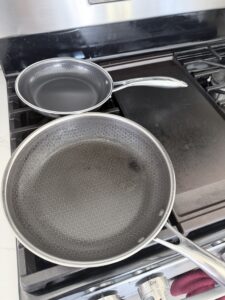
I’ve been using HexClad pans for about a year now, and somehow they’ve become the ones I reach for most without even thinking about it.
They’re just easy. I don’t worry about scratching them, they heat evenly, and they handle most day-to-day cooking without any drama. For a “grab and go” pan, they’ve kind of taken over my kitchen.
That said, they’re not the miracle pan the ads make them out to be.
I’ve worked in restaurants that used Vollrath stainless steel pans, and honestly, those performed better for things like eggs. Once you know how to preheat stainless properly, eggs release cleanly and predictably. With HexClad, I’ve found it actually takes more oil and more careful heat control to get similar results. It’s a bit counterintuitive for something marketed as nonstick.
That’s really where HexClad can feel a little temperamental. It wants a pretty specific heat range, and if you miss it, food is more likely to stick than you’d expect. It’s not as forgiving as true nonstick—and in some cases, even less forgiving than well-used stainless.
For searing, I still reach for cast iron. No contest there.
I don’t actually have any high-end stainless at home these days, so HexClad fills that middle ground pretty well with a few adjustments. A bit more oil, a little more attention to heat, and it works. It’s versatile, durable, and “good enough” at almost everything, which is probably why I keep using it.
Maybe someday I’ll spring for a set of Viking or Heritage Steel—something 5- or 7-ply. That kind of cookware just wasn’t something you saw in restaurant kitchens back when I was cooking professionally in the early to mid ’80s. Until then, HexClad gets the job done.
It’s worth the money—but it’s not the last pan you’ll ever need.
Construction and Safety
HexClad uses a tri-ply construction: an aluminum core sandwiched between two layers of stainless steel. The signature look comes from a laser-etched hexagonal stainless steel lattice that rises above the nonstick valleys, which is what protects the coating and lets you use metal utensils.
Historically, these pans were coated with PTFE. However, as of 2024, the company transitioned to their proprietary “TerraBond” ceramic-based coating, which is advertised as PTFE-free and PFAS-free.
Identifying Your Pan
If you are trying to figure out if your pan has the newer non-PTFE ceramic coating, you can check the serial number located on the underside of the handle or helper handle.
- “CBY” serial numbers: These typically indicate the newer pans manufactured with the TerraBond ceramic coating.
- “BY” serial numbers: These often refer to older models that used the original PTFE-based coating.
If you aren’t sure, you can always reach out to HexClad customer service with your serial number, as they can confirm the specific date of manufacture and coating type for you.
In no way is there any regret for our purchase of Hexclad. If you are looking into the cookware, they feel as though they may last a lifetime. Just do not expect the results that are advertised, there is a bit too much hype.
UPDATE
No sooner than writing this piece, the pans “non-stick” began wear off. The pans will be heading back to the store, luckily they were purchased at Costco. My previous statement of owning them nearly a year is off a bit, they were purchased almost seven months ago.
In my case, the pan lasted about the same length of time as a twenty dollar pan.

Leave a Reply
You must be logged in to post a comment.